
Electric service problems can be especially confusing when one room goes dark while electricity continues working throughout the rest of your Knoxville home. You may reset a breaker, test a lamp, or replace a bulb and still find dead outlets, inactive switches, or flickering fixtures. That localized failure is more than an inconvenience: it may point to a tripped safety device, an overloaded branch circuit, a failed receptacle, or a loose connection capable of producing dangerous heat. Fortunately, a single-room outage can often be narrowed down without opening an electrical panel or touching exposed wiring. This guide explains the most likely causes, the safe checks homeowners can perform, the warning signs that require immediate professional attention, and how a qualified electrician can restore reliable power while protecting your home.
Why One Room Can Lose Power While the Rest of the House Works
Electricity is distributed through a home using multiple branch circuits. Each branch circuit supplies a defined group of lights, receptacles, appliances, or rooms from the main electrical panel. Because these circuits operate independently, a problem affecting one branch may leave the rest of the property functioning normally.
Room boundaries do not always match circuit boundaries. An outlet in a bedroom might share a circuit with a hallway light, an adjoining bathroom receptacle, or an exterior outlet. Likewise, one room may contain devices connected to two or more circuits. This is why a single-room outage can sometimes affect unexpected locations—or leave one receptacle working while nearby devices remain dead.
A localized power loss may involve:
- A circuit breaker that has tripped
- A GFCI receptacle protecting downstream outlets
- An AFCI breaker responding to a possible arc fault
- An overloaded branch circuit
- A loose neutral or hot-wire connection
- A worn receptacle, switch, or light fixture
- Damaged wiring inside a wall
- A failed connection at the electrical panel
- A problem caused by an appliance or plug-in device
The pattern of the outage provides useful clues. Note which lights, outlets, ceiling fans, and hardwired devices stopped working before attempting any basic checks.
First Confirm That the Problem Is Limited to One Area
Before treating the issue as a room-specific wiring failure, check whether other portions of the property are affected. Walk through nearby rooms and test a few lights and outlets. Look outside to see whether neighboring properties have power.
A widespread utility interruption can affect an entire house, but certain service problems may cause only part of a home to lose electricity. For example, a residential service normally supplies two energized legs. If one leg is interrupted, some 120-volt circuits may continue operating while others fail. Large 240-volt equipment may also stop working or behave abnormally.
Contact the utility provider when:
- Several unrelated rooms lose power simultaneously
- Some major appliances stop working with no obvious breaker trip
- Half of the panel appears inactive
- Lights throughout the home become unusually bright or dim
- Exterior service conductors appear damaged
- A storm, fallen limb, or nearby utility work preceded the outage
Do not approach a fallen line or damaged service cable. Keep everyone away from the area and report the hazard immediately.
Safe Checks to Make Before Requesting a Repair
Homeowners can perform a limited visual and operational review without removing outlet covers, opening equipment, or handling wiring. Stop immediately if you notice heat, smoke, sparks, buzzing, or a burning odor.
Test the Device, Not Just the Outlet
A lamp, charger, television, or power strip may fail independently of the home’s wiring. Plug a known working device into the affected receptacle. Then test the original device in an outlet that still has power.
For a ceiling light, install a known working bulb of the correct type and wattage. If the fixture remains dark, determine whether other devices controlled by the same wall switch have also stopped working.
This simple comparison can prevent a working circuit from being mistaken for a wiring failure.
Check Wall Switches and Switched Receptacles
Some receptacles are controlled by wall switches, particularly in bedrooms and living rooms designed for plug-in lamps. Someone may have turned off a switch that is rarely used or mistaken it for another control.
Check every switch in and immediately outside the room. A duplex receptacle can also be split so that one half remains continuously energized while the other half is switch-controlled. Test both portions separately.
Do not repeatedly operate a switch that feels hot, makes a crackling sound, produces a flash, or sits loosely in the wall. Those symptoms require professional inspection.
Reset the Circuit Breaker Correctly
Open the panel door only if the area is dry, well-lit, and free from visible damage. Do not remove the panel cover. Stand to the side and visually inspect the breaker handles.
A tripped breaker does not always move fully to the OFF position. It may rest in the middle, making it appear normal at a glance. Locate the breaker associated with the affected room, move it firmly to OFF, and then return it to ON.
Follow these precautions:
- Unplug appliances and portable devices in the affected area.
- Reset the breaker once.
- Observe whether power returns.
- Stop if it trips again immediately or shortly afterward.
- Leave the breaker off when there are signs of a short circuit or damaged equipment.
Never hold a breaker in position, tape it on, or reset it repeatedly. A recurring trip means the protective device is detecting a condition that should be diagnosed rather than bypassed.
Look for a Tripped GFCI Receptacle
A ground-fault circuit interrupter is designed to disconnect electricity rapidly when current follows an unintended path. GFCI protection is commonly associated with kitchens, bathrooms, garages, laundry areas, basements, crawl spaces, and outdoor locations.
One GFCI receptacle can protect additional outlets connected downstream. As a result, a tripped device in a bathroom, garage, or exterior area may shut off a receptacle in another room.
Search for outlets marked TEST and RESET. Check:
- Bathrooms
- Kitchen countertop areas
- The garage
- Laundry spaces
- Unfinished basement areas
- Outdoor receptacles
- Crawl-space access points
- Utility rooms
Press RESET firmly. If the button will not stay engaged, the device may lack incoming power, have reached the end of its service life, or be responding to an active fault. Do not force it or attempt to defeat its protective function.
Inspect Plug-In Equipment for Overload Clues
Portable heaters, air conditioners, hair tools, gaming computers, vacuum cleaners, and other high-demand equipment can overload a branch circuit when operated together. Power strips create extra connection points but do not increase a circuit’s available capacity.
Think about what was running immediately before the outage. Unplug nonessential devices before resetting the breaker. If power remains stable until a specific appliance is reconnected, that equipment may be defective or may draw more current than the circuit can safely support.
Heat-producing appliances should generally be connected directly to an appropriate wall receptacle rather than an extension cord or ordinary power strip. Extension cords are intended for temporary use and may overheat when undersized, damaged, covered, coiled, or heavily loaded.
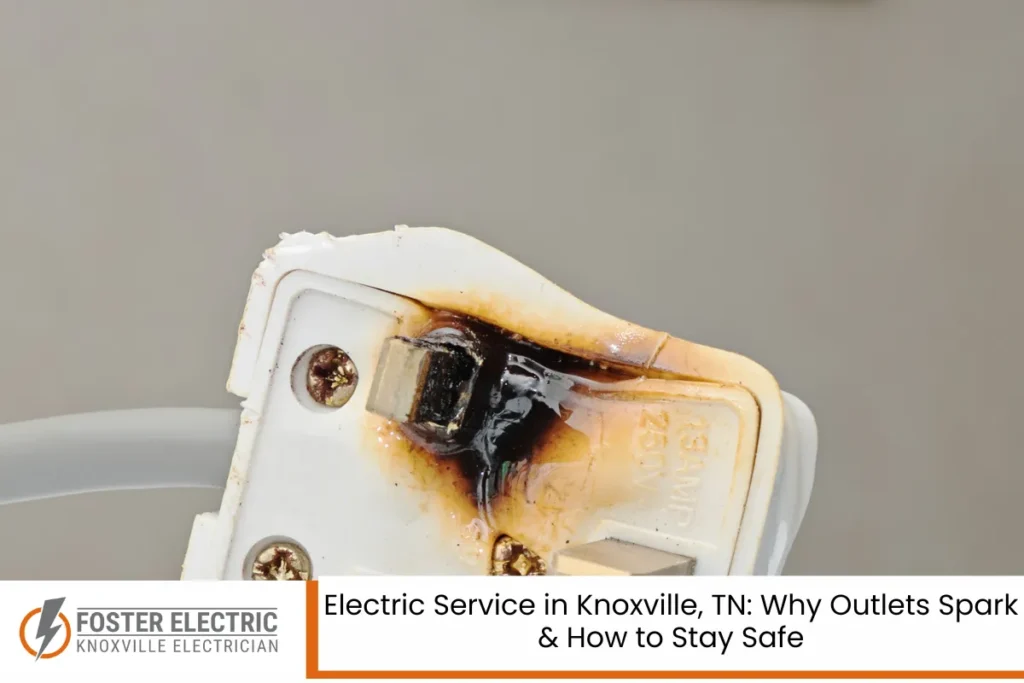
Read Electric Service in Knoxville, TN: Why Outlets Spark & How to Stay Safe
Seven Common Causes of Single-Room Power Loss
1. An Overloaded Branch Circuit
Every branch circuit has a current limit determined by its conductor size and overcurrent protection. When connected loads exceed that limit, the breaker trips to reduce the risk of conductor overheating.
A bedroom circuit can become overloaded when it supplies several computers, monitors, portable heaters, entertainment systems, and charging devices. Older floor plans may place multiple rooms on one circuit, making the actual load greater than it appears.
Common overload patterns include:
- The outage occurs when a heater or vacuum starts
- The breaker stays on after devices are unplugged
- Power fails during predictable periods of heavy use
- Several plug-in appliances share one receptacle or power strip
- The breaker feels normal but trips repeatedly under load
An electrical contractor can calculate the connected load, identify which devices share the circuit, and determine whether additional circuits would improve safety and convenience.
2. A GFCI Device Has Interrupted Downstream Power
A GFCI receptacle compares the electrical current leaving and returning through the circuit. A small imbalance can cause it to open, helping reduce shock risk.
Downstream wiring allows one device to protect several standard-looking receptacles. This configuration is useful but can make troubleshooting less intuitive. The reset controlling a dead bedroom or utility-room outlet may be located several feet away.
A GFCI that trips repeatedly should not simply be reset indefinitely. Moisture, damaged cords, failing appliances, incorrect connections, or deterioration inside the device may be responsible.
3. An AFCI Breaker Detected a Potential Arc Fault
Arc-fault circuit interrupter protection is intended to recognize electrical signatures associated with dangerous arcing. An arc can occur at a loose terminal, damaged cord, crushed cable, deteriorated conductor, or compromised connection.
Unlike a straightforward overload, an arc fault may be intermittent. Power could fail when furniture moves, a receptacle is used, or a particular appliance operates. Resetting the breaker may temporarily restore electricity without correcting the underlying cause.
Possible indicators include:
- Crackling behind a switch or outlet
- Intermittent flickering
- A breaker that trips without a large appliance running
- Discoloration around a device
- A plug that fits loosely
- Power changes when a cord or wall plate is touched
Avoid using the affected circuit until it has been evaluated. Arcing can generate substantial heat even when the current is not high enough to trip a conventional breaker immediately.
4. A Loose Connection Opened the Circuit
Residential circuits often feed multiple devices in sequence. Power may enter one receptacle, continue to another, and then supply additional outlets or fixtures. If a connection opens at one point, every downstream device can lose power.
The failed connection may be located at the last working device rather than the first dead one. That distinction is important because the visibly affected outlet may not contain the actual defect.
Loose connections can develop from repeated heating and cooling, device wear, vibration, improper installation, or damaged terminals. They may produce resistance, localized heating, flickering, buzzing, and eventually an open circuit.
Locating the fault requires systematic testing with suitable instruments. Because energized troubleshooting and exposed conductors create shock and arc hazards, this work belongs with a trained professional.
5. A Receptacle or Switch Has Failed
Outlets and switches are mechanical devices with components that wear over time. Repeated plug insertion can weaken receptacle contacts, while frequent switching can deteriorate internal contacts. A damaged device may stop functioning or interrupt power traveling to other devices.
Warning signs include:
- Plugs fall out or feel unusually loose
- The outlet face is cracked
- A switch operates inconsistently
- A device feels warm without a heavy load
- Scorching or dark marks appear around the openings
- A faint burning smell is present
- Power returns when pressure is applied to the device
Do not continue using a damaged receptacle or switch. Replacement may appear simple, but the circuit should first be examined for overheated conductors, incorrect connections, box damage, and other conditions that affect the proper repair.
6. Wiring Was Damaged Inside the Wall
Cable can be damaged by screws, nails, remodeling, pests, moisture, excessive heat, or physical movement. A fastener used to hang shelving or artwork may penetrate a concealed conductor. Renovation work can disturb an existing splice. Rodents may compromise insulation in an attic, crawl space, or wall cavity.
Hidden cable damage may cause an immediate trip, an intermittent outage, or no visible symptoms until the conductor deteriorates further. Stop using the circuit and arrange electrical service when the outage began after:
- Drilling or fastening into a wall
- Installing cabinets or built-in shelving
- Water intrusion
- Attic or crawl-space work
- Remodeling or demolition
- Pest activity
- A strong impact against the wall
Do not cut into drywall to search for the problem without first establishing the wiring path and safely de-energizing the circuit.
7. The Breaker or Panel Connection Is Defective
Circuit breakers can wear out, sustain heat damage, or develop poor contact with the panel bus. Conductors can also loosen at terminals. These conditions may interrupt electricity even when the handle appears to be on.
Panel problems require particular caution. The interior contains energized components, and portions may remain live even when the main disconnect is turned off. Homeowners should never remove the dead front or attempt to tighten breaker terminals.
Professional testing can determine whether the fault is in the branch wiring, the breaker, or the panel connection. A qualified electrician can also look for corrosion, incompatible components, overheating, damaged bus material, and improper modifications.
What the Outage Pattern May Reveal
The exact combination of working and nonworking devices helps narrow the likely cause.
Every Outlet and Light in the Room Is Dead
A tripped breaker, open connection near the beginning of the circuit, upstream GFCI, or panel problem is likely. Check adjacent areas because the circuit may extend beyond the room.
The Lights Work, but the Outlets Do Not
The lighting and receptacles may be supplied by separate circuits. A GFCI device, failed receptacle, switched outlet, or loose connection may be responsible for the outlet loss.
One Outlet Works While the Others Are Dead
The working device may be located upstream of an open connection. The defect might be at that last energized receptacle or at the first nonworking one.
Half of a Duplex Outlet Is Inactive
The receptacle may be intentionally split and controlled by a switch. It could also have a failed internal connection or damaged tab. Test the associated wall switches before requesting repair.
Power Flickers Before Failing
Flickering often points toward a loose connection, failing device, damaged conductor, or unstable neutral. Because intermittent resistance can produce heat, this pattern deserves prompt attention.
The Breaker Trips Immediately After Resetting
An active short circuit, ground fault, damaged device, or severe wiring problem may be present. Leave the breaker off and arrange an inspection rather than attempting another reset.
Warning Signs That Make the Situation Urgent
A dark room alone is not always an emergency. Certain accompanying symptoms, however, suggest that the affected circuit should remain off until it is inspected.
Arrange prompt professional assistance when you notice:
- Smoke, sparks, or visible arcing
- A burning-plastic or hot-insulation odor
- Buzzing, sizzling, or crackling
- Warm or discolored wall plates
- Repeated breaker or GFCI trips
- Water near wiring, outlets, or the panel
- Shocks or tingling from appliances
- Sudden extreme brightness or dimness
- Melted plugs or receptacle openings
- A damaged electrical panel or service cable
Call emergency services when there is an active fire. Do not use water on energized electrical equipment. Leave the property when smoke, flames, or severe arcing creates an immediate hazard.
Troubleshooting Steps Homeowners Should Avoid
Online instructions can make electrical repairs appear easier than they are. A single-room outage may involve energized conductors, shared neutrals, concealed junctions, or a connection outside the visibly affected area.
Avoid the following actions:
- Removing the electrical panel cover
- Touching exposed conductors
- Replacing a breaker without confirming compatibility
- Installing a higher-amperage breaker to prevent trips
- Bypassing an AFCI or GFCI device
- Using a jumper wire to test a circuit
- Working near standing water or active leaks
- Continuing to use a warm or scorched receptacle
- Resetting a breaker repeatedly
- Assuming a noncontact tester proves that wiring is safe
Installing a larger breaker on wiring that is not rated for it can allow conductors to overheat before protection operates. Similarly, defeating a safety device removes protection without correcting the fault.
How a Professional Diagnoses the Failed Room Circuit
A systematic diagnostic process is safer and more efficient than replacing parts at random. The electrician begins by discussing when the outage started, what equipment was operating, and whether any recent repairs, storms, leaks, or renovations occurred.
The evaluation may include:
- Mapping the affected devices
- Confirming breaker operation
- Testing voltage at the panel and branch circuit
- Checking hot, neutral, and grounding paths
- Locating upstream GFCI or AFCI protection
- Identifying the last working and first failed device
- Examining receptacles, switches, and fixtures
- Testing for continuity on a de-energized circuit
- Checking for loose or overheated connections
- Evaluating connected appliance loads
- Inspecting accessible attic or crawl-space wiring
The final repair depends on the finding. It may involve replacing a failed device, correcting a loose splice, repairing damaged cable, changing a defective breaker, separating excessive loads, or installing an additional circuit.
A competent diagnosis should resolve the cause—not merely restore power temporarily.
Knoxville Permits, Inspections, and Code Considerations
The City of Knoxville enforces adopted construction codes, including the National Electrical Code, to establish minimum safety requirements for electrical installations. The city adopted the 2023 edition of the NEC through an ordinance approved in 2024. Permit requirements and administrative procedures can depend on the project scope, property location, and type of work.
Electrical permits for addresses within Knoxville city limits are obtained through the City of Knoxville rather than the local utility. Outside city limits, the applicable permitting and inspection authority may differ. Homeowners should confirm jurisdiction before work begins instead of assuming one process applies throughout the surrounding area.
The city requires permit applicants to hold the registration or qualifications applicable to the work. Certain projects may also involve Tennessee licensing requirements. At the state level, a contractor’s license is required before bidding or negotiating projects with a total cost of $25,000 or more, although additional local registration and limited-license rules may apply below that threshold.
A small diagnostic visit does not necessarily involve the same permit process as rewiring a room, adding a circuit, relocating devices, or replacing a panel. The responsible electrical contractor should determine whether the proposed repair requires authorization and inspection.
Preventing Another Room-Specific Outage
Not every failure is preventable, but several habits can reduce circuit stress and expose developing problems earlier.
Learn What Each Breaker Controls
A clear, accurate panel directory makes troubleshooting easier during an outage. Labels such as “bedroom” may be incomplete when the circuit also supplies a hall, closet, or adjacent room. Update the directory after circuit tracing or electrical improvements.
Reduce Dependence on Power Strips
Power strips should not be used as a permanent substitute for adequate receptacles or branch circuits. Connecting multiple strips together increases the chance of overload and creates more points where heat can develop.
Give High-Demand Equipment Appropriate Capacity
Portable heating and cooling equipment can consume much of a typical branch circuit’s capacity. Avoid operating several high-wattage devices on the same circuit. A dedicated circuit may be appropriate for equipment with substantial or continuous demand.
Replace Damaged Cords and Loose Devices
Frayed cords, bent plug blades, cracked receptacles, and loose connections should be addressed promptly. Do not rely on tape to repair a damaged appliance cord or continue using an outlet that no longer grips plugs securely.
Test Protective Devices Regularly
Use the TEST and RESET buttons according to the device manufacturer’s instructions. A GFCI that fails its test should be evaluated and replaced as appropriate. AFCI testing procedures may differ, so follow the panel and breaker documentation.
Investigate Flickering Instead of Ignoring It
Occasional dimming when a large motor starts can have an identifiable load-related cause. Persistent, widespread, or worsening flicker may indicate a connection problem and should be examined before it progresses into a complete outage.
Restoring the Circuit Without Compromising Safety
When one room loses power, begin with the simplest safe possibilities: confirm the lamp or appliance works elsewhere, check wall switches, look for an upstream GFCI, and reset the correct breaker once after unplugging room loads. These steps can resolve minor interruptions without exposing anyone to energized wiring.
When power does not return—or when it returns only temporarily—the circuit needs more than trial-and-error replacement. A loose connection, hidden cable defect, failed breaker, damaged outlet, or recurring fault can create shock and fire risks even though the rest of the home appears normal.
Treat burning odors, buzzing, warmth, discoloration, and repeated trips as warnings. Leave the circuit off and arrange qualified electrical service so the underlying defect can be located, repaired, and tested in accordance with applicable Knoxville requirements.
Electric Service in Knoxville, TN – Foster Electric
At Foster Electric, we help homeowners resolve single-room outages, dead receptacles, breaker problems, flickering lights, and other electrical concerns safely and efficiently. Our team provides dependable electric service in Knoxville, Tennessee, as well as prominent surrounding areas. We trace the affected circuit, identify the actual source of the failure, and explain practical repair options before work proceeds. Whether the problem involves a worn outlet, damaged wiring, an overloaded circuit, or a faulty protective device, we focus on lasting solutions rather than temporary fixes. Do not ignore repeated trips, warm wall plates, buzzing, or burning odors. Call Foster Electric at (865) 246-7037 or fill out our contact form to schedule professional service for your home.
Frequently Asked Questions
Can a smart switch cause an entire room to lose power?
A failed smart switch can interrupt power to the light or fixture it controls, but it does not ordinarily shut down every receptacle in a room unless other devices were improperly connected through the same box. Smart controls also require compatible wiring, and many models depend on a neutral conductor. Loose terminals, an incorrect installation, internal electronics failure, or an incompatible lamp load can cause intermittent operation. If resetting the smart device does not solve the problem, turn off the affected circuit and request an inspection. Replacing the switch without checking its wiring may conceal an unsafe connection or damage the new control.
Can a power surge cause a delayed outage in one room?
Yes. A surge may weaken a breaker, receptacle, electronic switch, surge protector, or appliance without causing an immediate total failure. The damaged component can continue operating briefly before heat, internal deterioration, or normal use causes it to stop conducting electricity. A plug-in surge protector may also sacrifice itself and disconnect connected equipment. After a storm or switching event, inspect accessible devices for damage and unplug sensitive electronics from the affected area. When multiple outlets remain dead, the breaker will not reset, or unusual odors and sounds appear, an electrician should test the circuit and determine whether concealed components were affected.
Why does power return to the room after several minutes?
Power that returns without a breaker reset may indicate a loose connection, overheating device, failing appliance protector, or damaged conductor that makes and breaks contact as temperature changes. Some equipment contains internal thermal protection that automatically resets after cooling, but that would usually affect the appliance rather than every device in the room. An intermittent connection within the branch circuit is more concerning because resistance can generate heat inside an outlet box or wall cavity. Turn off high-demand devices and avoid using the circuit until it is examined. Intermittent power should not be treated as a harmless inconvenience simply because electricity eventually returns.
Can LED bulbs make it seem like a room has an electrical problem?
LED lamps can flicker, glow faintly, or stop working because of incompatible dimmers, failing drivers, loose bulbs, poor-quality components, or fixtures that trap excessive heat. When every outlet remains functional and only one light fixture behaves abnormally, the lamp, dimmer, or fixture may be the likely source. Test a compatible bulb of the correct rating before assuming the branch circuit has failed. However, several fixtures flickering together may indicate a loose connection or voltage problem. Persistent brightness changes, buzzing controls, hot switches, or repeated lamp failures deserve professional evaluation rather than repeated bulb replacement.
Does homeowners insurance cover repairs after a room loses electricity?
Coverage depends on the policy and the cause of damage. Insurance may help with sudden losses caused by covered events such as certain storms, fires, or accidental damage, but it commonly excludes ordinary wear, poor maintenance, defective workmanship, and the cost of replacing a component that simply reached the end of its service life. Damage to appliances may also be treated differently from damage to permanent wiring. Document visible conditions, preserve receipts, and contact the insurer before major restoration work when a covered event may be involved. Emergency measures needed to prevent further damage should still be handled promptly and safely.
Disclaimer: This article provides general safety information, not instructions for energized electrical work. Permit requirements and site conditions vary. Contact the appropriate Knoxville authority and a qualified electrical professional before modifying wiring, breakers, panels, or protective devices.
Reach Electric Service in Knoxville, TN: Faulty Wiring Repair Costs & Estimates